Introduction
The phrase 30.6df496–j261x5 in Milk has started appearing in online searches, forums, and discussions, causing confusion among consumers who are trying to understand whether it refers to a milk ingredient, a food additive, a contamination marker, or a dairy industry code.
After review of Romanian dairy legislation, food labeling legislation, and milk quality and technical requirements, there is currently no official information/proof confirming 30.6df496-j261x5 as an official milk-related code in Romania. The code can not be found in the Romanian dairy law, in accepted food additive lists, or on public databases of food safety information.
Romanian consumers would most likely ask, “Does this code relate to Milk safety, production, or quality?” I have examined the available data, explained how Milk is governed in Romania, and managed to keep the story factual.
Quick Overview
| Question | Answer |
| Is 30.6df496–j261x5 an approved milk ingredient in Romania? | No evidence suggests this. |
| Is it a Romanian dairy quality standard? | No. |
| Is it an EU food additive code? | No. |
| Does it appear in public Romanian food regulations? | No. |
| Should consumers be concerned? | Not based on current evidence. |
Why Are People Searching for 30.6df496–j261x5 in Milk?
Usually, some strange search terms would be noticed if someone mentions that word or abbreviation on the blog, forum, inventory software, database, social media, and so on. And 30.6df496-j261x5 in Milk, it looks like a software code and does not resemble the name of a food ingredient.
Several characteristics support this conclusion:
- It contains a mix of letters, numbers, and symbols.
- It does not follow Romanian food labeling conventions.
- It does not match European additive numbering systems.
- It lacks any recognized scientific or nutritional terminology.
- It resembles internal database references commonly used in manufacturing systems.
Any technical identifier that’s stumbled upon can rapidly be fodder for speculation as consumers look to search engines when seeking information about food safety.
Understanding How Milk Is Regulated in Romania
Dairy Laws and the EU Standard. It’s worth noting that Romania has in place extremely strict dairy rules that, fortunately, go with EU food standards. Anyone who produces and sells Milk commercially should be up-to-date on a wide number of rules, including production processes, how it is stored, how it can be shipped, and its labeling, and a quality standard.
Romanian dairy producers must ensure that milk products meet established standards for:
- Fat content
- Protein content
- Microbiological safety
- Animal health compliance
- Traceability
- Packaging information
- Consumer labeling
The regulations are to allow consumers to distinguish between real dairy products and products they are purchasing, and to clarify the difference between the products they buy and those they are buying.
Unlike official dairy classifications, 30.6df496–j261x5 in Milk does not appear to correspond to any recognized category used by Romanian dairy authorities.
What Information Should Appear on Romanian Milk Packaging?
When purchasing Milk in Romania, consumers should focus on official labeling information rather than unfamiliar alphanumeric strings.
A properly labeled milk package typically contains the following information:
| Label Information | Why It Matters |
| Product Name | Identifies the milk type |
| Producer Details | Shows the manufacturer |
| Country of Origin | Indicates production location |
| Expiration Date | Important for safety |
| Fat Percentage | Nutritional information |
| Storage Conditions | Helps maintain freshness |
| Batch Number | Enables product tracing |
| Volume | Product quantity |
These are the details that Romanian food inspectors and consumers rely upon when assessing a product’s authenticity and safety.
Could 30.6df496–j261x5 be a Manufacturing Identifier?
One of the most realistic explanations is that the code originated from an internal industrial system.
Modern dairy facilities use digital tools for:
- Production monitoring
- Inventory management
- Quality assurance
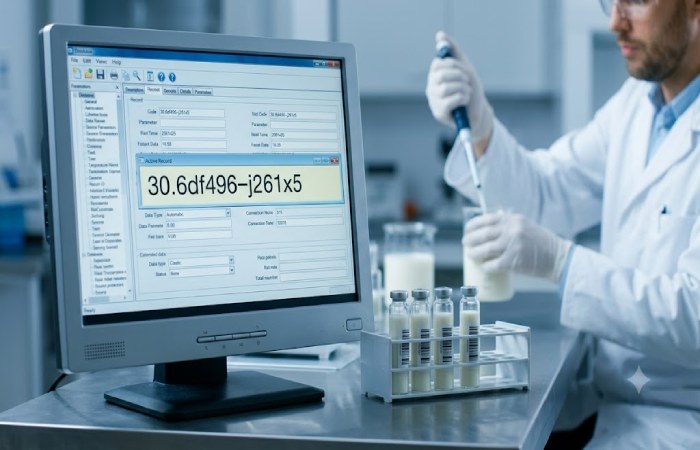
- Laboratory testing
- Warehouse tracking
- Logistics operations
A manufacturing system may generate thousands of unique identifiers every day. These identifiers are often intended only for internal use and are never meant to be seen by consumers.
Possible sources include:
Internal Tracking Systems
Large dairy processors frequently assign unique references to products, ingredients, or production batches.
Software Testing Environments
Developers commonly create placeholder codes during testing phases.
Database Records
Technical databases often use automatically generated strings that have no consumer-facing meaning.
Exported Reports
A system-generated report may accidentally expose internal identifiers that later become searchable online.
This explanation is currently more plausible than the theory that 30.6df496–j261x5 in Milk represents a regulated food substance.
Romanian Milk Industry at a Glance
Romania has one of Eastern Europe’s important dairy sectors. Milk production supports thousands of farms and contributes significantly to the country’s agricultural economy.
Major Characteristics of Romanian Dairy Production
- Cow’s Milk remains the dominant dairy source.
- Both small farms and industrial producers operate nationwide.
- Quality standards are aligned with EU regulations.
- Dairy exports have increased over the last decade.
- Traceability systems are becoming increasingly digital.
Common Types of Milk Sold in Romania
| Milk Type | Typical Use |
| Whole Milk | Household consumption |
| Semi-Skimmed Milk | Everyday drinking |
| Skimmed Milk | Low-fat diets |
| UHT Milk | Long shelf life |
| Organic Milk | Premium market |
| Lactose-Free Milk | Digestive sensitivity |
None of these categories contains references to identifiers such as 30.6df496–j261x5 in Milk.
What Official Food Codes Actually Look Like
Many consumers mistake random identifiers for food additives because they are familiar with E-numbers.
However, European food additives follow a completely different structure.
Examples include:
| Additive | Purpose |
| E300 | Vitamin C |
| E322 | Lecithin |
| E330 | Citric Acid |
| E471 | Emulsifiers |
| E500 | Baking Agents |
These codes are standardized, regulated, and documented throughout the European Union. The format of 30.6df496–j261x5 in Milk does not resemble this system in any way.
Could It Be Related to Milk Testing?
Laboratories involved in dairy quality control perform numerous tests every day.
Common milk tests include:
Microbiological Testing: Used to detect harmful bacteria.
Fat Content Analysis: Determines nutritional value and product classification.
Protein Testing: Measures milk composition and quality.
Antibiotic Residue Screening: Ensures compliance with food safety standards.
Shelf-Life Evaluation: Assesses product stability over time.
Laboratories often assign unique identifiers to samples, making it possible that 30.6df496–j261x5 could be a sample reference number. However, there is currently no public Romanian documentation connecting the code to any official testing procedure.
Why Random Codes Sometimes Become Internet Trends
The internet often amplifies obscure technical information.
Several factors contribute to this phenomenon:
- Search engine curiosity
- Social media sharing
- AI-generated content repetition
- Database leaks
- Misinterpreted technical documents
- Forum discussions
When users encounter an unfamiliar string such as 30.6df496–j261x5 in Milk, they naturally assume it may have scientific or regulatory significance.
In reality, many such identifiers originate from technical systems rather than food science.
Consumer Checklist: How to Verify Milk Safety in Romania
Instead of worrying about unexplained online codes, Romanian consumers should evaluate milk products using practical criteria.
Check the Product Label
When you are about to buy any product, you should read the product label and check ingredients, fat content, manufacturer details, country of origin, and storage information.
Verify the Expiration Date
Be aware of Milk that will soon expire. Before you purchase Milk, examine the expiration date for the freshest quality, greatest taste, and nutrient level, as well as for optimal safety.
Buy From Trusted Retailers
When buying Milk, make sure you only do this from good-quality and approved grocery shops or markets. The grocery shops should maintain clean and good storage facilities with a reliable refrigeration system. They should follow strict guidelines with regard to food safety rules.
Inspect the Packaging
Always choose containers that aren’t leaking, dented, or bulging, and don’t buy those with broken seals.
Review Storage Conditions
Ensure Milk is stored at recommended temperatures in stores and at home to maintain freshness and prevent spoilage.
Confirm Producer Details
Check the producer’s information on the packaging to verify authenticity and ensure the product comes from a recognized manufacturer.
Focus on Verified Information
Rely on official labeling and food safety guidance instead of unverified online claims about unknown milk-related codes.
Myths vs Facts
| Myth | Fact |
| 30.6df496–j261x5 is a secret milk additive. | No evidence supports this claim. |
| The code indicates contamination. | No verified source confirms this. |
| Romanian authorities use this identifier. | No public documentation shows this. |
| It is an EU food additive. | The format does not match EU additive standards. |
| Consumers should avoid Milk linked to the code. | There is no evidence suggesting a health risk. |
Final Verdict
Based on available Romanian dairy information, 30.6df496–j261x5 in Milk does not appear to be a recognized ingredient, additive, contaminant, quality standard, or regulatory classification. The code is far more likely to be a technical identifier originating from a software system, database, laboratory environment, or inventory platform.
To minimize these risks, Romanians are encouraged to rely on proven information such as the list of ingredients and additives, expiry date, nutrition value table, the name and address of the producer, the quality certificate, and food safety labeling. While unusual codes can generate curiosity online, there is currently no credible evidence linking 30.6df496–j261x5 in Milk to any known health risk or dairy industry requirement in Romania.
Frequently Asked Questions
What is 30.6df496–j261x5 in Milk?
Based on current data, it most likely refers to a technical code, not to a dairy ingredient, additive, or food safety code that is commonly used or recognized.
Is it dangerous?
There is no verified information indicating that the code represents a hazardous substance.
Does Romania regulate it?
No Romanian dairy regulation currently lists this identifier as a recognized food-related classification.
Is it found on milk packaging?
There is no evidence that it forms part of standard Romanian milk labeling requirements.
Should consumers report it?
The manufacturer or the Romanian food safety authority must be contacted in case a dairy product does not have all required labeling information, or in case the product seems to be problematic.